
Criminal Cases in the Jasper County Courts
Jasper County criminal cases do not all go to one bench. Felonies and serious misdemeanors prosecuted by the Fourteenth Circuit Solicitor belong in the South Carolina Circuit Court's Court of General Sessions. The Jasper County Clerk of Court maintains those files at 265 Russell Street in Ridgeland. Magistrate courts hear matters within summary-court jurisdiction, while the Hardeeville and Ridgeland municipal courts keep city traffic, ordinance, and misdemeanor files within their authority.
The court that heard the charge controls where a complete Jasper County court record can be obtained. The Ridgeland Magistrate Court is at 967 West Adams Street, and the Hardeeville Magistrate Court is at 21 Martin Street. The county magistrate directory shows both local desks.
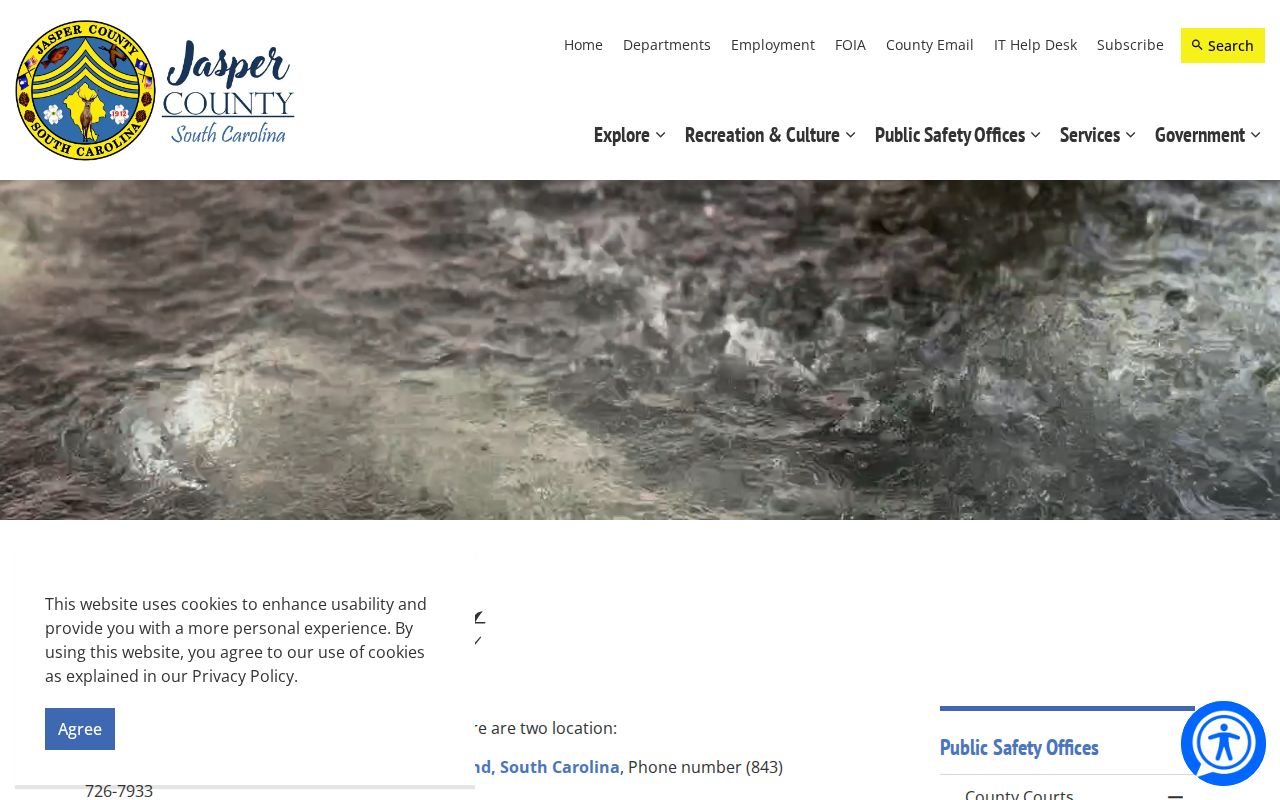
That official directory helps a searcher contact the correct summary court instead of assuming the General Sessions clerk holds every local criminal file.
Inside Jasper County's Case Index
The free Jasper County Public Index is the main remote starting point for filed court events. It can show the case number, court agency, filing date, case type, assigned judge, parties, attorneys, charges, hearing dates, chronological actions, bond entries, sentence text, and financial events when those fields have been entered. It is a court docket, not a fingerprint-based statewide criminal history.
Search results require care. A case-level status does not necessarily state what happened to each charge. Open the case and read the disposition and disposition date for every count. A missing document image also does not mean the document never existed. The index does not promise downloadable pleadings for every case, and old paper material may require a call to the custodian.
How to Search Case Records
Use a known Jasper County case number first because it points to a specific file. A party search is the next best route. Exact spelling, middle names, date limits, court agency, and case type can separate similar names. When the index returns no useful result, confirm whether the charge belongs to General Sessions, a magistrate court, or a city court before concluding that no case exists.
- Open the Jasper County Public Index and choose the search method that matches the information in hand.
- Enter the case number when known. Otherwise, search the party's last and first names with exact spelling.
- Narrow broad results with a middle name, court agency, criminal case type, or filing date range.
- Open the docket, compare identity details, and read each charge's disposition, hearings, actions, sentence, and bond entries.
- Contact the court clerk for older files, missing images, or a certified copy. The General Sessions desk is 843-726-7710.
| Field Label | Type | Required | Notes |
|---|---|---|---|
| Search Type | Tabs | One method | Case, party, judgment, and calendar options may appear. |
| Case Number | Text | No | The most precise route when the full court number is known. |
| Last / First / Middle Name | Text | No | Spelling and aliases affect results; middle name narrows matches. |
| Court Agency / Case Type | Dropdown | No | Limit results to participating Jasper County courts and criminal categories. |
| Date Range | Date fields | No | Limits filing or event dates where the court configuration offers it. |
The search interface may vary by court configuration. Record the court agency shown on a useful result because that office, not merely the county name, identifies the custodian for follow-up.
When Jasper County Court Records Stay Offline
The Public Index is an access layer, not the whole Jasper County case file. Contact Clerk Keith Horton's office when a docket points to a pleading that cannot be opened, when an older case appears to remain on paper, or when a certified copy is needed. The General Sessions counter is at 265 Russell Street, Ridgeland, SC 29936. It is open from 9:00 a.m. to 5:00 p.m. on weekdays except legal holidays, and its phone is 843-726-7710. The county warns that parking is very limited.
The clerk maintains filed cases but does not perform broad record checks. A request for a statewide name-based history belongs with SLED CATCH. For a specific Jasper County docket, provide the court agency, case number, party name, and the exact filing or certification needed. That distinction keeps a request with the office that can answer it.
The official Jasper County online payment route is tied to eligible court obligations.
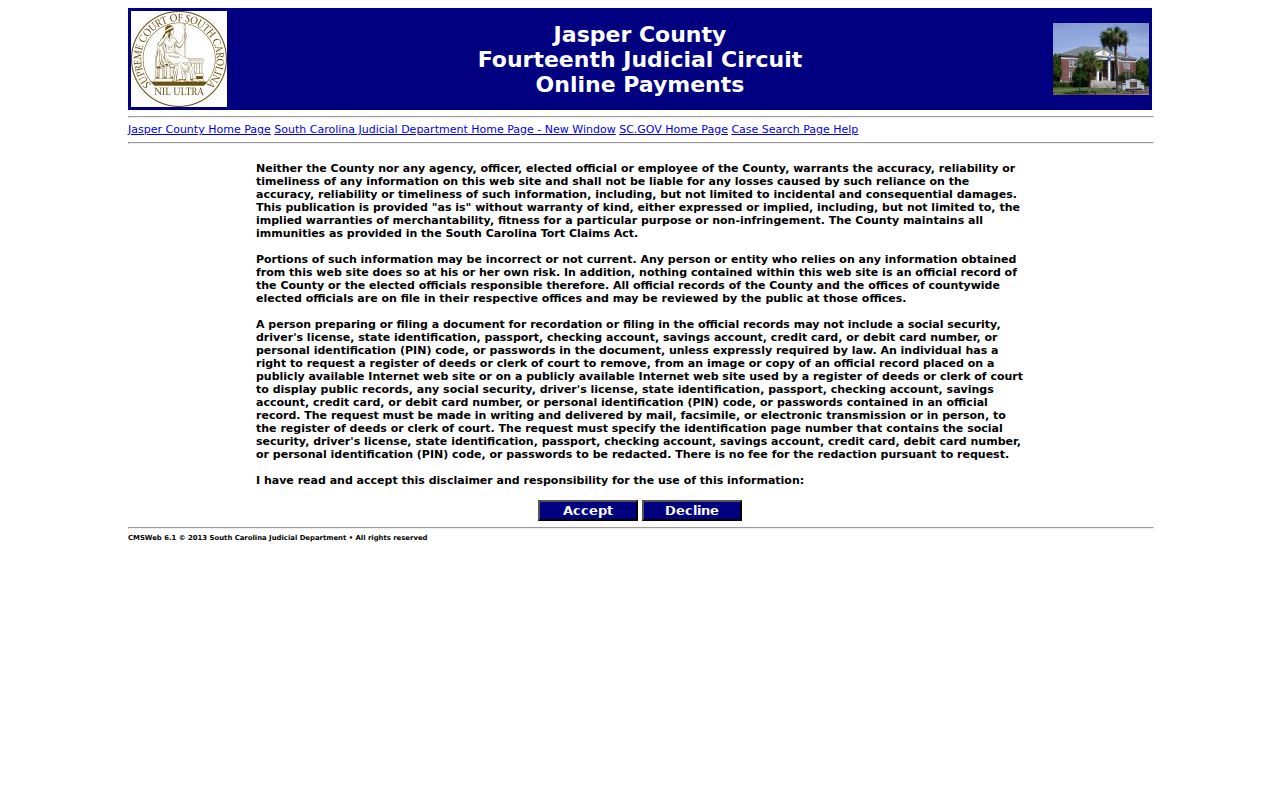
A payment screen does not replace the docket or prove a charge's outcome, so verify the case number and court entry before interpreting it.
What the Case File Shows
A Jasper County court file is case-centered. It connects the filed charge to hearings, motions, pleas, disposition, and sentence. It differs from a jail booking record, which records custody intake, and from a SLED CCH, which links qualifying fingerprint-supported cycles across South Carolina. Follow the filed charge through its final or current outcome.
| Case Number & Court | Identifies the court agency and the unique Jasper County file. |
|---|---|
| Charging Information | Lists offense descriptions, statutes, incident dates, and counts as entered. |
| Docket Entries | Shows the dated sequence of filings, actions, motions, and other events. |
| Hearings & Bond | Can identify scheduled hearings, bond entries, and related court action. |
| Disposition | Records the outcome of each charge and its disposition date. |
| Sentence & Finance | May show sentence text, balances, and payment events where entered. |
Available documents vary by Jasper County case. The index is not a promise that each pleading, order, or image can be downloaded from the public view.
Reading Jasper County Case Dispositions
Do not treat the word “closed” as a conviction. Case status describes the file as a whole, while a charge-level disposition describes the result of one count. A prosecutor may enter a nolle prosequi, meaning the charge will not proceed at that time. A dismissal ends that charge without a conviction. An acquittal is a not-guilty finding, and a conviction follows a guilty plea or verdict.
- Disposition
- The final or current outcome recorded for a charge.
- True bill
- A grand jury approves an indictment for General Sessions.
- No bill
- A grand jury declines to approve the proposed indictment.
- Arraignment
- The charge is formally presented and a plea is entered.
- Nolle prosequi
- The prosecutor formally declines to proceed at that time.
South Carolina class labels can also appear beside an offense. The official felony and misdemeanor classification law sets six felony classes and three misdemeanor classes, while many exempt crimes carry their own penalties.
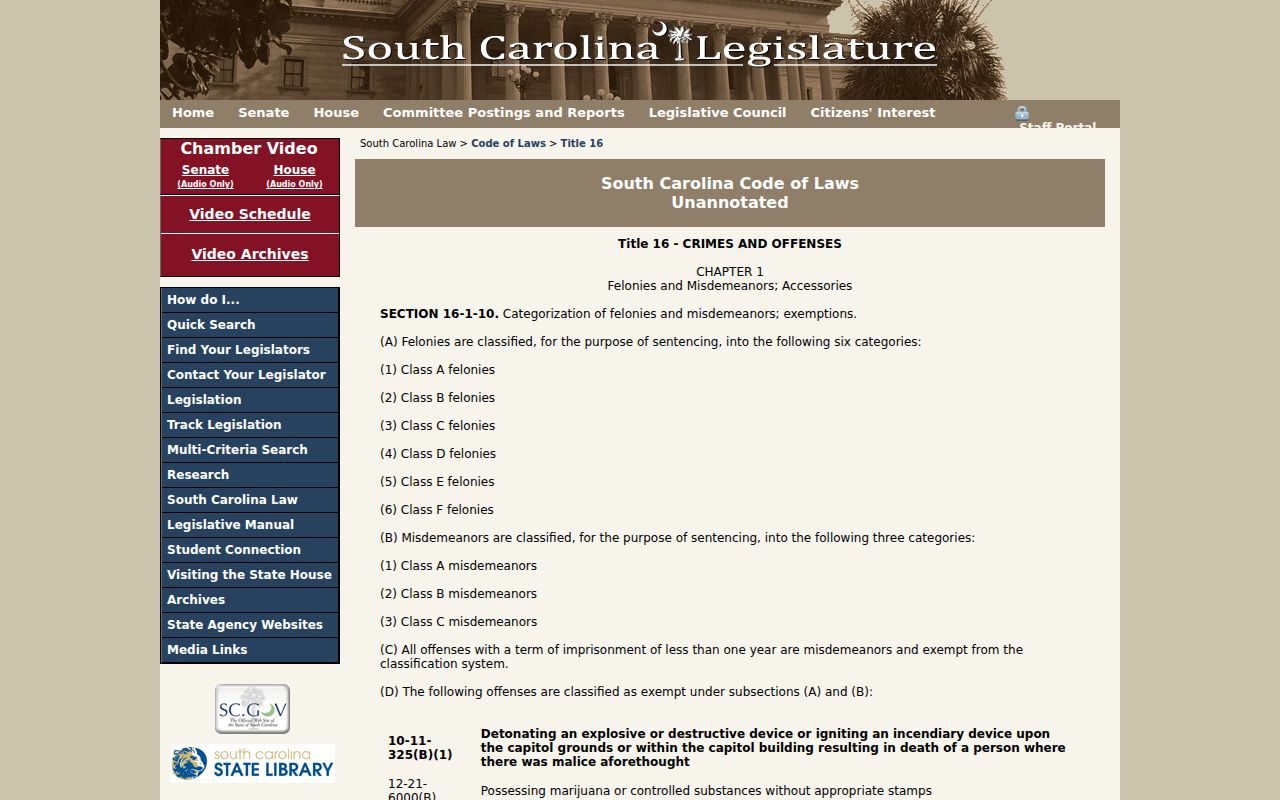
The statute should be checked directly because a short offense label in a Jasper County docket may not state the full punishment rule.
Stages of a Criminal Case
A Jasper County criminal matter can begin with an arrest or summons. Bond and an initial appearance may occur before the prosecutor completes screening. General Sessions charges proceed through indictment where required, arraignment, discovery and motions, then a plea or trial. A conviction leads to sentencing, while appeals or post-conviction proceedings may add later entries. No fixed local duration was published, so docket dates are the sound way to track one case.
Case flow: Charges Filed › Arraignment › Pretrial › Plea or Trial › Disposition › Sentencing
All Jasper County bond hearings occur at the detention-center Bond Court. Magistrates can set bond in criminal matters except murder and first-degree burglary. Those two charges fall outside magistrate bond authority.
Jasper County Criminal Courts Compared
The correct Jasper County court depends on the offense and jurisdiction. General Sessions handles felonies. Magistrate courts exercise summary criminal and traffic jurisdiction authorized by law. Hardeeville and Ridgeland municipal courts handle city misdemeanors, traffic matters, and ordinances within their authority. Both city courts participate in the state court management system, but participation does not make every local file a General Sessions record.
| Court | Main criminal role | Contact |
|---|---|---|
| General Sessions / Clerk | Felony and serious criminal case files | 265 Russell St.; 843-726-7710 |
| Central Bond Court | All county bond hearings and most bond decisions | 12008 N. Jacob Smart Blvd.; 843-726-7737 |
| Ridgeland Magistrate | Summary criminal and traffic matters | 967 W. Adams St.; 843-726-7933 |
| Hardeeville Magistrate | Summary criminal matters | 21 Martin St.; 843-784-2628 |
| Municipal Courts | City misdemeanor, traffic, and ordinance matters | Hardeeville 843-784-3366; Ridgeland 843-726-7500 |
The South Carolina summary-court procedure provisions supply the state framework for these lower-level criminal matters.
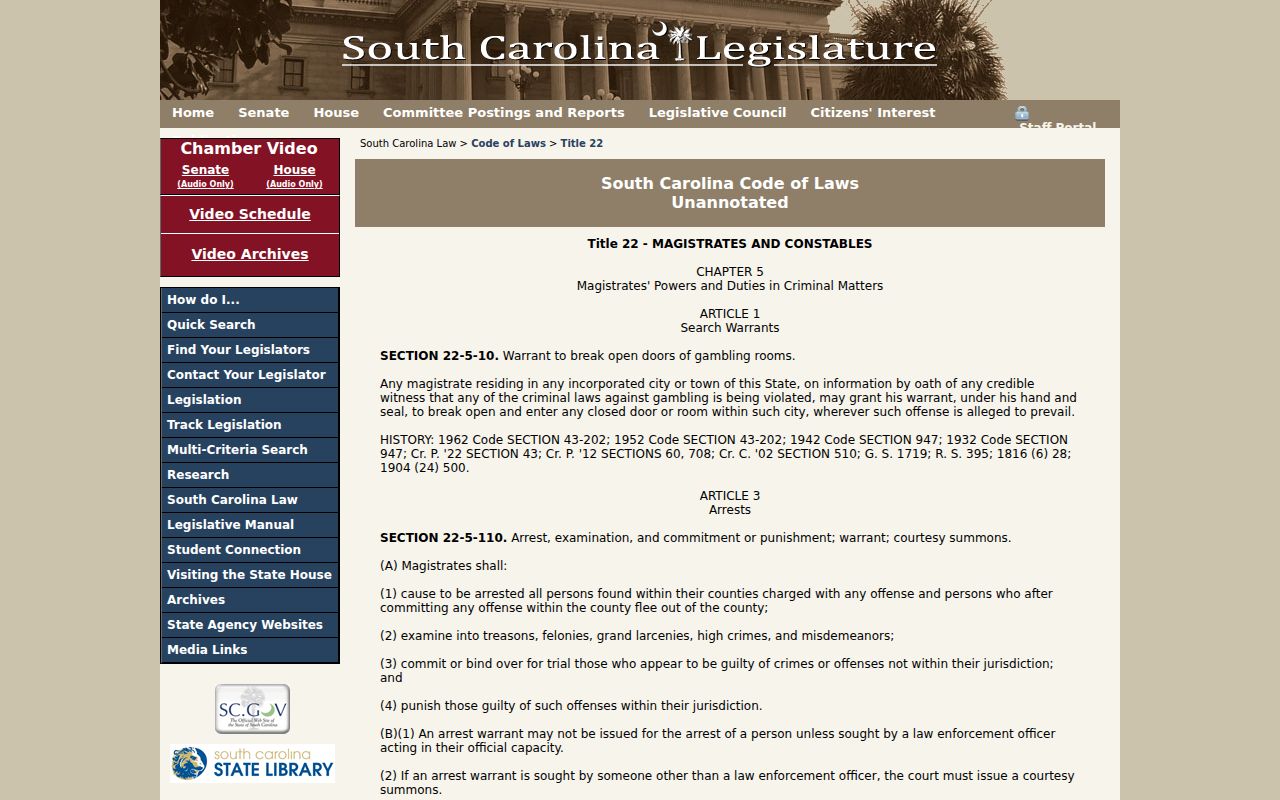
The source helps explain why a summary-court file can follow a different path from a General Sessions indictment.
Jasper County Federal Court Records
A federal charge is not filed in Jasper County General Sessions. Jasper County lies in the U.S. District Court for the District of South Carolina, and federal dockets are searched through PACER after account registration. The docket controls the hearing location, assigned judge, filings, and current schedule. A county arrest alone does not show that a federal case exists.
The South Carolina Judicial Branch Jasper directory identifies the county's Fourteenth Circuit and local court structure.
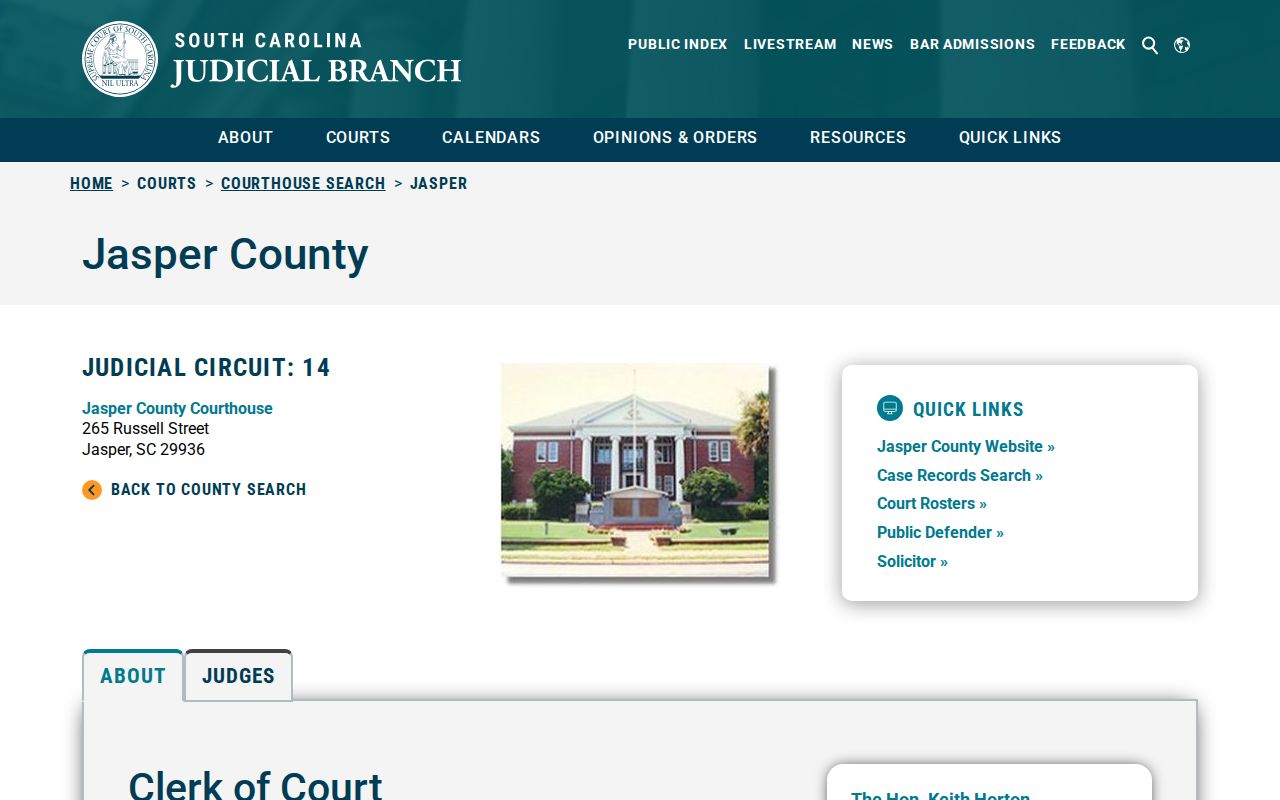
That state directory routes county cases, while the federal district court remains a separate system.
For the federal layer, use the U.S. District Court for South Carolina as the official court source.
The district site and PACER should be checked instead of assuming a Jasper County courthouse maintains federal pleadings.
Access & Restrictions
South Carolina court records are subject to public-access rules, but access is not absolute. Juvenile matters, expunged charges, sealed records, protected victim or minor data, personal identifiers, and some active investigative material do not appear like ordinary public case information. Online entries may omit identifiers and documents that a public counter also cannot lawfully release.
The South Carolina Freedom of Information Act supports inspection and copying of public records while preserving statutory exemptions. South Carolina's pretrial intervention and expungement provisions also explain why a qualifying charge may later become unavailable through ordinary public access. A Public Index absence can result from spelling, court selection, age, reporting lag, or paper-only storage. Ask the specific clerk about a known case number and the public copy sought. For the arrest-to-charge trail behind a docket, the separate Jasper County arrest history resource explains the sheriff, detention, and police channels.